Book Prices: Why a Good Story Should Be Worth More Than a Cheeseburger


0228071452a.jpg

Photo by The Consumerist

So everyone loves cheap, right? I mean, who can resist a great sale or a "steal" of a deal? It's human nature to want the most for your money.

But this week I found myself wanting the new Stephen King book, 11/22/63, and pausing because of the price. It's a hardback, which I don't typically buy--mainly because they're heavy and more awkward to read. And the retail price is $35. But of course, you never have to pay full price. You can get it 30% off at places like Target and you can get it for right under $20 at Barnes and Noble or Amazon. 

But still, it's twenty bucks, which *feels* like a lot when I'm used to buying paperbacks.

Then I started reading the reviews on Amazon and saw that a few reviewers gave the book one star solely on the price (which of course, should not be part of a review) and arguments amongst reviewers ensued.

Many made good points and this got me to thinking.

We'll pay that price to go see a movie, to go eat a lackluster meal at Applebee's, we'll spend five bucks on a cup of coffee that takes minutes to make and even fewer minutes to consume.

But we'll balk at paying that price for a 1000-page novel by a talented author who probably spent months to years writing and researching for it? AND that book will give us not minutes, but hours, days, of pleasure, of getting lost in a world, of rich entertainment.

THAT isn't worth the cost of a delivery pizza and some soda?

We've lost perspective on what the value of a good book is, of art.

Part of it is because we just live in a discounted/free/cheap focused world. We're the Walmart generation. Who cares if children work 18 hours days in impoverished countries and sleep under their sewing machines to make this shirt? It's only three dollars! 

Part of it is the economy and we're all just watching every penny. But it seems we take stands on some things but then blindly spend money in other places.

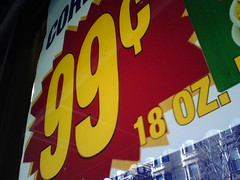
And another piece of the equation is the recent self-pubbing boom where everyone is offering full-length ebooks for free, 99 cents, or on the "high" end, $2.99.

Now, a small price for a short story or a short novella makes sense to me. But for full length novels?

Yes, those prices have made a few millionaires, but they also create a slanted view of what a book is worth. And honestly, my perception of those books is often lower. It's not a conscious thing but when  my mind sees 99 cents it automatically makes me think of dollar store quality. I may download one on occasion, especially if it's a "free" thing, but getting around to reading them--meh, I don't get so excited about it. The only ones I get excited about is if it's a promotion and I'm already a fan of the author and know I enjoy their stories.

I think it was Dr. Phil who used to say "you teach people how to treat you." Well, I think we're teaching people what we're worth. Authors are undervaluing themselves and their books. Something that takes you six months or a year to write, shouldn't be able to be had for a buck. It shouldn't be the same price as the Christmas pencils in the dollar bin at Target.

I think it's going to start to hurt authors more than it helps. Here's an opinion from indie-pubbed author Selena Kitt:

"Kindle readers are tired of $0.99 cheapies. The shine is off the new toy, people have stopped loading their Kindles up with freebies and cheapies, and have started getting more discerning about what they download. Many Kindle readers are starting to shy away from the $0.99 price point because they’ve read some stinkers and don’t want to travel down that road again. What was once a huge draw for Kindle readers—oooh, look, cheap books for my new toy!—has now become the opposite."


So I'm not going to stress about the price of the Stephen King book anymore. I can afford the twenty dollars. I'll just get that instead of the new pajama pants I had in my cart. And if I didn't want to spend the money, I could get it at the library. Or I could wait until it comes out in paperback. That's how books work.

So how about you? What are your thoughts on book prices? Should books cost the same amount as a Snickers bar? What do you spend money on mindlessly that costs the same as a good book? What do you think when you see the 99 cent price point--does it color your idea of its quality before reading? Do you think people will get burnt out on the cheap ebook thing because there is so much bad stuff to sift through to find the good ones? 
Do You Trust Reviews? - The Hierarchy of Book Buying

blaine

Photo by Jeff Nelson (cc)

This week on one of the author loops I'm on, there has been a discussion about book reviews--particularly ones on Amazon and Goodreads. One of the authors on the loop linked to this discussion on Amazon by readers about "padded" reviews. Meaning--the author's family, friends, and minions go and jack up the average by writing 5-star glowing reviews.

Be warned, some of the readers in that discussion are pretty harsh in their opinions of authors--kind of painting us like we're these evil puppetmasters who look to deceive readers by getting biased reviews. Some even go so far as to say they never trust a five star review and think the ones are much more valid. Any other author reading this get a shudder of fear over that one?

Now, I am not going to sit here and say that some authors don't send their friends and family over to give them reviews. It happens. But my guess would be that it's a very small part of reviews. And I get most wary when I see a book only has say 5 or 6 reviews and all of them are five stars with "this book is perfection" kind of reviews. But if a book has a good number of reviews and most are positive, I tend to believe it. (I like looking at the average rating.)

However, this whole discussion did get me to thinking how I as a reader (not a writer) look at reviews when I'm making purchasing decisions. And you know what? I do kind of skip over the 5-star ratings (unless it's by a review site I recognize) and I ALSO discount the 1-star ratings. Ninety-five percent of the time the one-star raters have some bigger issue outside of this specific book (they thought it was going to be in a different genre, there was too much sex i.e. they didn't realize it was erotic, or they took some personal offense to the book.) Those reviews aren't helpful to me.

So I usually gravitate toward reading the 2-4 star reviews. I'm not so concerned with the number of stars as I am what the people said about the book. That's usually where I get the most helpful info to let me know if it's going to be a book for me or not. So even as an author, I'm inadvertently discounting those 5-star reviews. Ouch.

But really, for me, the reviews on those sites kind of fall low on my radar when it comes to buying books. It's not so much as a lack of trust as it is I know opinions vary so greatly. For instance, the movie critics loved Contagion. I thought it was completely boring, lacking conflict, and had zero character development.

So here's kind of my hierarchy chart for book buying. 


My Hierarchy of Book Buying

AUTO BUY


  • It's an author I already know and love. Blurb doesn't really matter. He or she has proven to me that their books are made of win. Until they prove otherwise, I'm buying.


PROBABLY BUY

  • Recommendation from a friend whose tastes are similar to mine.

The old word of mouth thing. It works. I know the friends I have that recommend winners to me every time.

  • If it's a publisher I trust + Good Blurb

I know this may be more of a writer thing because we're more aware of who is publishing what. But way before I ever had an agent or a deal with Berkley, I was a Berkley fan girl. I knew that I liked 95% of what they put out, so as long as the story blurb interests me, I will usually buy.


STRONGLY CONSIDER BUYING

  • Good blurb + Good cover

Yes, covers shouldn't matter. But they do. If the story souds interesting and the cover looks great, I'm in.

  • Good review on a book blog or review magazine I know and trust.

These are the reviews that I think are much more worthwhile. You find those book bloggers who have similar tastes to you and then you can get recommendations that you can trust.


MAY CONSIDER BUYING

  • Good Blurb + Good ratings on Amazon/Goodreads

As you can see, this is very low on the list. All the ones above are how I make most of my decisions. Maybe this is because I don't totally buy into reviews, or maybe it's just because I'm buying so many books for the above reasons, that I rarely get down to this point.


WON'T BUY

  • Blurb I'm not interested in.
  • Genre I don't read.
  • Clearly homemade cover 

I know it's not fair. But especially with indie pubbed stuff, the cover to me is the first sign of whether or not the person has put forth the effort to be professional. If they didn't spend money on cover design, they probably didn't worry about paying a good editor either. (Not saying that's always true, but just telling you how my mind automatically responds.

  • A lot of reviews and they're mostly bad

A few bad reviews won't scare me off, but if that's the majority of what the book received, I'm probably not buying.


So that's how I make my decisions, but I'm curious to hear how you make yours?

Do you put a lot of stock in Amazon and Goodreads reviews? Do you trust 5-star (or 1-star) ratings? What makes you most want to buy a book? What scares you off a book? What book blogs can you always count on for reliable reviews? What would your hierarchy of book buying look like?


How Do You Like Your Endings?


Going Nowhere...

Photo by Leah Jones (creative commons)

This week I raced through the book Goodnight Tweetheart  by Teresa Medeiros. My friend Ashley March recommended it and the premise intrigued me--a whole romance novel composed mostly of tweets. My husband and I met online through chat (back when people still used AOL) and so of course, that kind of romance is something close to my heart.

The book was fun and full of pop culture references (many from the 80s and 90s) that I could relate to. I found myself laughing a number of times. However, this story is a poignant one and takes a turn 2/3 of the way through that deepens what started as a light-hearted story.

It was wonderfully written and I really enjoyed the book, but when I got to the end, things were left on a hopeful note but not a fully wrapped up one. And I was left turning the pages, dying for an epilogue. I even went to the author's website to see if there was "bonus" content that gave us more. 

Now this was an artistic decision and a testament to how good the story was because I was emotionally attached and wanted to know more about these characters. But it got me to thinking about endings.

I am an unapologetic happy ending whore. I like my stories wrapped up and riding into the sunset by the end. I don't necessarily need the big wedding or anything, but I want to be left with the sense that these two people will be together and will have a happy life. 

If someone pulls a Nicholas Sparks on me and kills off a main character in a romance, I'm ready to wield a pitchfork. Hence the reason I like to read romances where I'm guaranteed my happy ending.

And maybe it's just me, but I kind of want it spelled out for me. I don't want to be left wondering if the couple is going to make it. And not just that, but I want to see the big "we're so in love and everything is going to work out" moment. So that was the only reason I gave this book 4 instead of 5 stars. One extra chapter at the end and I probably would've rated it a 5. (Regardless, I highly recommend it for a great read.)

Now if I go into a book knowing that it's not a happy ending kind of thing, I'm okay. I'm prepared. I mean, I didn't go into watch Titanic and expect it to be rainbows and sunshine. But I do tend to gravitate towards genres that are going to give me my happy at the end. And I can't imagine writing a non-HEA story.

So how do you feel about endings? Are you a happily ever after whore like me or do you prefer more open-ended finales? Have you ever read a book where you just needed a little more to get closure?

What Makes the Chronic Finisher Stop Reading

Tired Runner

Photo by Rennett Stowe

So up until about a year ago, I had this problem when I started reading a book. Once I peeled back the cover of one, I was compelled to finish it. No matter if I was fully enjoying the book or not. It felt like starting a book was like signing some contract. I bought this book. I've chosen to read it. And now I must read it all. I was the Chronic Finisher.

But then a lot changed in my life. I got a book deal and started writing on deadline. My then angelic two year old turned into an intense three year old. And my reading time shrunk to this minuscule sliver of time. So I found myself putting down books that didn't capture my interest. And then I wouldn't get any reading done because I felt like if I was going to read, I needed to finish whatever book I had started. But I wasn't into that book so didn't pick it up at all.

Well, finally, I came to the conclusion that I had to put the Chronic Finisher in rehab. I was missing out on good books by forcing myself to read ones I didn't love. My reading time is too short and my TBR pile too big to be doing that. So lately, I've been giving myself permission to give up on a book if it hasn't grabbed me by page 50 or so. (I know many of you are less forgiving than that, but three chapters or 50 pages feels about right for me. I give it a shot in case it's a slow starter.)

And each time I put down a book in the DNF (did not finish) pile, the writer in me wants to evaluate WHY I didn't feel compelled to finish it. What was bad enough to defeat the chronic finisher? Here's what I've discovered.


What Makes Even the Chronic Finisher Put Down a Book:


1. Didn't connect with the characters

If I can't relate to the hero or heroine at all or if I don't like them, I find it next to impossible to get into the book. I must be emotionally connected by chapter 3 at the very latest.


2. There was no chemistry or not enough build-up between the hero and heroine in a romance.

Obviously, I write sexy romance and enjoy reading it. But nothing will bore me quicker than throwing two people together when there hasn't been any tension or chemistry set up beforehand. This doesn't mean you can't have the characters get together quickly, but the author better have done a fabulous job building up that tension. (Liberating Lacey by Anne Calhoun comes to mind for a great example of how to do this right. The characters have a love scene very quickly, but the setup and chemistry are FABulous so it feels like the right time.)


3. This feels familiar...

Tired plots and clichés. Lately, this has happened most in the YA paranormal genre for me. If a book is going to have a girl meeting dangerous, mysterious new guy--there better be a helluva twist to make it different from all the other stories out there like that. (Good example of how to twist a popular trend: Richelle Mead's Vampire Academy.)


4. The BIG secret is the only sense of tension in the book.

I am fine with a secret in a plot. That can be great. (And by secret, I don't mean twist we don't see coming. That's something different. I mean we, the readers, know there is a secret.) But what I will not put up with for long is a book that drags out revealing what the BIG secret is to the reader for no apparent reason but to pull you along. This is when characters keep almost revealing what the big, bad thing is, but then someone walks into the room and interrupts them. Gah! I'm much more a fan of where the reader may know the character's secret early on, but the hero or heroine is keeping it from another character for good reason.


5. *Yawn* Boring....

This one is obvious I'm sure, but I need a book to hook and excite me. If I'm at page fifty and I don't give a crap what happens, then you've bored me. You should have me by chapter one. If the book goes on and on with description and setting up characters and not giving me any true action or conflict, I'm bored. Maybe that's a result of our fast-moving culture, but it is what it is. A book is entertainment, so entertain me. Dance, monkey, dance. :)


All right, so those are my top five reasons for putting down a book. What are some of yours? How long do you give a book to hook you? Are you a chronic finisher?


What I Write: It's Not About Handcuffs


Yes, this is Jared Leto. Yum.

(Photo of the "Hurricane" video via VH1)

Most of you know (or have figured out from that smoking hot book cover up there in the right hand corner) that I write erotic romance. And specifically I write in a subgenre of erotic romance--BDSM erotic romance.

What is BDSM? For those of you who aren't quite sure...

From Wikipedia (because they can summarize better than I can):

BDSM is a continuum of erotic practice and expression involving the consensual use of restraint, intense sensory stimulation, and fantasy power role-play. The compound acronym, BDSM, is derived from the terms bondage and discipline (B&D or B/D), dominance and submission (D&S or D/s), and sadism and masochism (S&M or S/M). BDSM includes a wide spectrum of activities, forms of interpersonal relationships, and distinct subcultures.

For those of you that are already eroRom readers, I'm sure you don't bat an eyelash that I write in this genre. BDSM is a huge, highly popular subgenre in erotic romance. But for those of you who haven't read much in the genre, the idea of BDSM may be a bit intimidating or too "out there." Images of leather-clad people wearing heavy eyeliner and dog collars may flit through your mind. You may be thinking, "Why on earth would I want to read about that? And how can this be a romance novel?"

But believe me, the types of stories in this subgenre run the gamut. If you want the extreme, it's out there. But also out there are stories about every day people who happen to like things a little (or a lot) edgier in the bedroom. Characters who discover that something about this kind of relationship with another person feeds something inside them.

This is not a case of--oh hey, let's throw in some handcuffs and call this book BDSM. These stories are about people who on some soul deep level crave things like power exchange in the bedroom. Or at least that's how I write my characters. I write from the perspective that this is part of who they are--either because of life experiences or genetics or whatever. (*sings Lady Gaga's "Born This Way"*)

For instance, my heroine in CRASH INTO YOU, discovers she likes being sexually submissive early on in her adulthood, but then she's brutally attaked and raped. Now, ten years later, she's terrifed of giving control to someone else, yet the part of her that craves sexual submission is still in there. She's just tamped it down because even the thought of it sends her into a panic attack. (Of course this means I--evil author--had to put her in a position  where she had to face that fear.)

But she's not some alternative character that only people in the BDSM lifestyle could relate to (though there would be nothing wrong with it if she was.) She's a smart, successful social worker with a "normal" life. If you've never read erotic romance and you pick up my book, it's not going to feel like some "out there" genre. It's going to read like a romance because that's what it's about--love. (Don't believe me? You can read chapter one here.) Of course, there will be super hot sex scenes that include things you won't find in a non-erotic book, but hello--who wants to miss out on that? :)

So if you've never read "this kind of book", I encourage you to try it and not be intimidated. You will find more of the familiar than unfamiliar in them. (Here's a suggestion for what to try if you've never read BDSM romance.) And you never know, it may give you some ideas to try out with your own significant other. ;)

Oh, and because it's now in my head, a little Gaga for you...


 So, are you an erotic romance reader? Have you read a BDSM story before? If so, what are some of your favorites? If you haven't read one, are you at all intimidated by the genre? What would make you give a book in this genre a shot?