• Home
  • BOOKS
    • About Roni
    • Press Kit
    • FAQ
  • NEWSLETTER
  • Blog
  • Coaching
  • Classes
  • Contact
Menu

Roni Loren

Street Address
City, State, Zip
Phone Number
New York Times & USA Today Bestselling Author

Your Custom Text Here

Roni Loren

  • Home
  • BOOKS
  • About
    • About Roni
    • Press Kit
    • FAQ
  • NEWSLETTER
  • Blog
  • Coaching
  • Classes
  • Contact

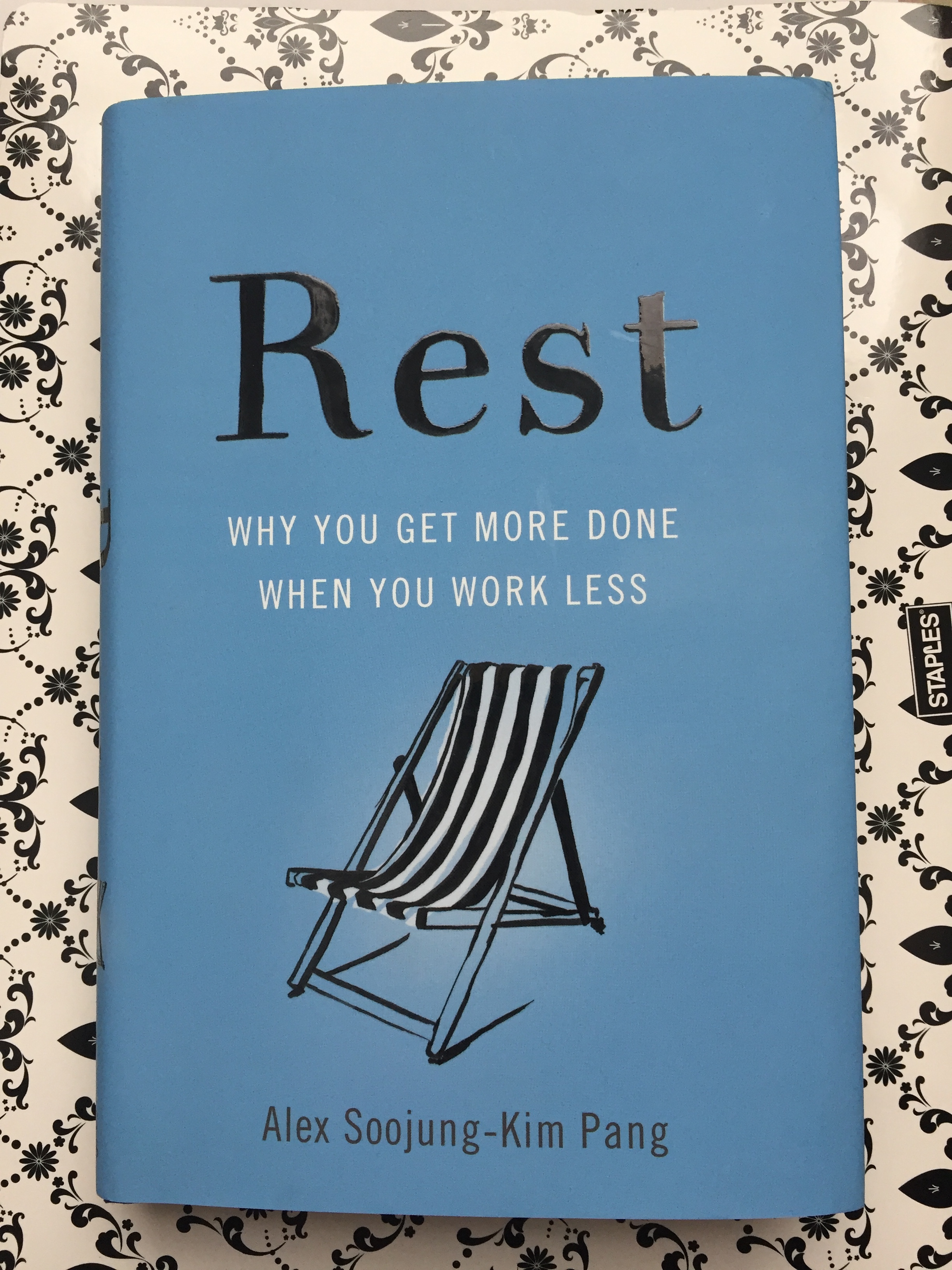
Recommended Read - Rest: Why You Get More Done When You Work Less by Alex Soojung-Kim Pang

August 25, 2017 Roni Loren
IMG_8045.JPG

There are books I read that I find helpful, and then there are books I read that I know are going to change something significant in my life. This book is the latter. I picked up Rest by Alex Soojung-Kim Pang because a) I'm obsessed with books on habits, productivity, and finding calm, as most of you know, and b) because I hadn't seen this topic tackled so extensively before. A book on rest, not sleep (though there's a chapter on that). That's an important distinction because rest can be active and purposeful. Rest can be magical.

As I've mentioned before, I have a tendency to suffer with writer's block and burnout. I figured that's a natural thing because I've spent the last 8 years writing about 300,000 words a year under deadline. I love my job but that doesn't mean it doesn't get stressful and overwhelming. So over the last few years, I've taken a big interest in productivity, creativity, and habits and have read books like Deep Work, Big Magic, Better Than Before, Essentialism, etc. It's an ongoing journey, so when I saw the premise and chapter titles of this book, I knew I needed to read it.

So what's my verdict? My highest recommendation. I think anyone in any type of creative, scientific, or business field should pick this up. There was so much great information, all backed up by extensive real world examples of other creatives, scientists, and business leaders along with the science and research studies that underline the points. The science parts are particularly helpful because it tells you how and why these methods work. (And gives you the justification for doing them. Science says so! lol)

I know I'll be taking away things like the four hour work window for focused/deep work, stopping in the middle while you still know what's going to happen next so your subconscious can work on it, having a morning routine and getting my writing done FIRST so that any rest or play later in the day is done without guilt. Those are just a few.

There were so many great nuggets of wisdom, I can't list them all here. But I will say that using a lot of these methods over the last week has resulted in a week of steady writing, hitting my word count every day, and having no stress about it. It's been fantastic.

So, I suggest you check out the book, but I also wanted to list the chapter titles so you can see the range of topics covered. 

Part 1: Stimulating Creativity

  • Four Hours
  • Morning Routine
  • Walk
  • Nap
  • Stop
  • Sleep

Part 2: Sustaining Creativity

  • Recovery
  • Exercise
  • Deep Play
  • Sabbaticals
 

About the book (back cover):

For most of us, overwork is the new normal and rest is an afterthought. In our busy lives, rest is defined as the absence of work: late-night TV binges, hours spent trawling the internet, something to do once we've finished everything else on our to-do lists. But dismissing rest stifles our ability to think creatively and truly recharge.

In Rest, Silicon Valley consultant Alex Pang argues that we can be more successful in all areas of our lives by recognizing the importance of rest: working better does not mean working more, it means working less and resting better. Treating rest as a passive activity secondary to work undermines our chances for a rewarding and meaningful life. Whether by making space for daily naps, as Winston Churchill did during World War II; going on hours-long strolls like Charles Darwin; or spending a week alone in a cabin like Bill Gates, pursuing what Pang calls "deliberate rest" is the true key to fulfillment and creative success. Drawing on rigorous scientific evidence and revelatory historical examples, Rest overturns everything our culture has taught us about work and shows that only by resting better can we start living better.

Now, go get a copy and get some rest this weekend! ;) 
In Book Recommendations, Books, Friday Reads, Life, Life Lessons, Productivity, What To Read, Writing Tags rest, producitivty, creativity, self-improvement, roni loren, books, reading, four hour work day

What I've Been Reading: 4 Recent Favorites

August 22, 2017 Roni Loren
What I've Been Reading.png

I think I'm going to declare the year 2017 my year of reading voraciously. At the beginning of the year, I set a goal to read 45 books for the year. This was a little lower than the previous year's goal because for the first time in years *sob* I didn't hit my Goodreads goal in 2016. But last week I actually hit my goal already. Woot!

Part of the reason I'm reading so much, beyond the fact that it's my favorite thing to do, is that, as many of you know, I've cut out so much of my online and smartphone time. Those gaps created have been filled in with more reading time--a happy switch I have to say. But that's left me with so many books that I want to tell you about and not enough time to blog fully about them all, lol.

So today I thought I'd give a quick rundown of what I've been reading lately and loving.


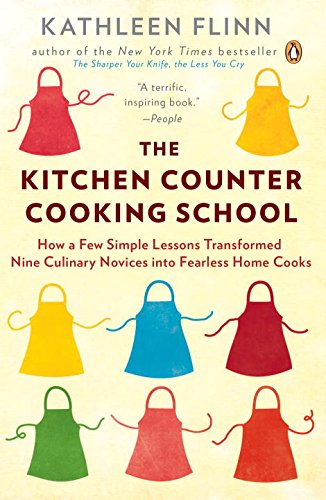
The Kitchen Counter Cooking School by Kathleen Flinn

I heard about this one first on the Modern Mrs. Darcy podcast and I knew I had to have it. I love a foodie book, but I was intrigued by the premise of this one--taking a group of women who didn't feel confident in the kitchen and showing them simple ways to cook without complicated recipes and a lot of fuss. Now, I consider myself a pretty experienced cook since it's a hobby of mine, but I still learned a ton of things in this book. For one, I've been holding my chef's knife all wrong! All this time. I had no idea. But beyond the cooking tips, I loved hearing about each woman's individual story and experiences. I listened to this one in audio and then had to buy the paperback too because I wanted all the little tips and simple recipes given.

About the book:

The author of the New York Times bestseller The Sharper Your Knife, The Less You Cry tells the inspiring story of how she helped nine others find their inner cook.

After graduating from Le Cordon Bleu in Paris, writer Kathleen Flinn returned with no idea what to do next, until one day at a supermarket she watched a woman loading her cart with ultraprocessed foods. Flinn's "chefternal" instinct kicked in: she persuaded the stranger to reload with fresh foods, offering her simple recipes for healthy, easy meals. The Kitchen Counter Cooking School includes practical, healthy tips that boost readers' culinary self-confidence, and strategies to get the most from their grocery dollar, and simple recipes that get readers cooking.


Someday, Someday, Maybe by Lauren Graham

Yes, by that Lauren Graham of Gilmore GIrls fame. This is a fictional story about an actress in New York trying to make it in the nineties. You can definitely hear Graham's voice in the story and you get the sense that though it's a fictional tale, she's using a lot of personal experiences to flavor it. I thought that added a level of authenticity I'm not sure I've read in other books with actress heroines. This one was very upbeat and fun. Sometimes I wanted to yell at the character because her self-esteem is so shaky at times and I just want to give her a rah-rah, don't-sell-yourself-short talk, but she's very likable and endearing. There's a slight romance thread in the book but don't expect a spelled out ending for the romance. At the end, it was one that I kept turning the pages because I was hoping for an epilogue. Sadly, no epilogue, but the journey was worth it. A breezy read.

About the book:

From Lauren Graham, the beloved star of Gilmore Girls and Parenthood, comes a witty, charming, and hilariously relatable debut novel about a struggling young actress trying to get ahead―and keep it together―in New York City.
 
It’s January 1995, and Franny Banks has just six months left of the three-year deadline she set for herself when she came to New York, dreaming of Broadway and doing “important” work. But all she has to show for her efforts so far is a part in an ad for ugly Christmas sweaters, and a gig waiting tables at a comedy club. Her roommates―her best friend Jane, and Dan, an aspiring sci-fi writer―are supportive, yet Franny knows a two-person fan club doesn’t exactly count as success. Everyone tells her she needs a backup plan, and though she can almost picture moving back home and settling down with her perfectly nice ex-boyfriend, she’s not ready to give up on her goal of having a career like her idols Diane Keaton and Meryl Streep. Not just yet. But while she dreams of filling their shoes, in the meantime, she’d happily settle for a speaking part in almost anything—and finding a hair product combination that works.
 
Everything is riding on the upcoming showcase for her acting class, where she’ll finally have a chance to perform for people who could actually hire her. And she can’t let herself be distracted by James Franklin, a notorious flirt and the most successful actor in her class, even though he’s suddenly started paying attention. Meanwhile, her bank account is rapidly dwindling, her father wants her to come home, and her agent doesn’t return her calls. But for some reason, she keeps believing that she just might get what she came for.
 
Someday, Someday, Maybe is a story about hopes and dreams, being young in a city, and wanting something deeply, madly, desperately. It’s about finding love, finding yourself, and perhaps most difficult of all in New York City, finding an acting job.
 

Around the Writer's Block by Rosanne Bane

I learned about this one in an RWA workshop and immediately had to go out and buy it. I suffer from writer's block at some point in almost every book and it's a huge source of stress for me. This book breaks it down and gives a simple system for setting up your brain for success so that you avoid burnout and blocks. SO HELPFUL. I've read a lot of books and articles on this topic, but this one really resonated with me. I loved all the science and explanations, and I found the system she suggests very intuitive. Highly recommended to my fellow writers.

About the book:

Discover the tricks that your brain uses to keep you from writing—and how to beat them.
Do you:
  • Want to write, but find it impossible to get started?
  • Keep your schedules so full that you don’t have any time to write?
  • Wait until the last minute to write, even though you know you could do a better job if you gave yourself more time?
  • Suddenly remember ten other things that you need to do whenever you sit down to write?
  • Sabotage your own best efforts with lost files, missed deadlines, or excessive self-criticism?
The good news is that you’re not lazy, undisciplined, or lacking in willpower, talent or ambition. You just need to learn what’s going on inside your brain, and harness the power of brain science to beat resistance and develop a productive writing habit.
In Around the Writer’s Block, Rosanne Bane-- a creativity coach and writing teacher for more than 20 years-- uses the most recent breakthroughs in brain science to help us understand, in simple, clear language, where writing resistance comes from: a fight-or-flight response hard-wired into our brain, which can make us desperate to flee the sources of our anxieties by any means possible.
Bane’s three-part plan, which has improved the productivity of thousands of writers, helps you develop new reliable writing habits, rewire the brain’s responses to the anxiety of writing, and turn writing from a source of stress and anxiety into one of joy and personal growth.
 

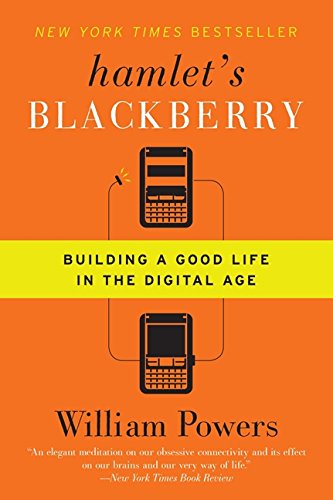
Hamlet's Blackberry by William Powers

Yes, I'm still obsessively reading books about digital life and the effects devices have on us. : ) But I'm sharing this one because I think it's one of the most readable ones yet and focuses on the philosophical side instead of the hard science side. Powers lays out the problems and struggles so many of us are having with focusing and feeling constantly busy in the digital age, then he pulls seven philosophers from history to examine how they handled radical shifts in technology. (Because we're not the first generation to have to deal with that kind of radical shift--think of when written language was developed, when the printing press was created, when radio and TV were invented). It was really interesting seeing how insights from philosophers of the past absolutely can be useful today in dealing with our own technology revolution. Then at the end, Powers gives practical idea for how we can better live in our digital worlds without losing our minds. (Also, even though this book was published 7 years ago, it's still just as relevant today.)

About the book:

A crisp, passionately argued answer to the question that everyone who’s grown dependent on digital devices is asking: Where’s the rest of my life? Hamlet’s BlackBerry challenges the widely held assumption that the more we connect through technology, the better. It’s time to strike a new balance, William Powers argues, and discover why it's also important to disconnect. Part memoir, part intellectual journey, the book draws on the technological past and great thinkers such as Shakespeare and Thoreau. “Connectedness” has been considered from an organizational and economic standpoint—from Here Comes Everybody to Wikinomics—but Powers examines it on a deep interpersonal, psychological, and emotional level. Readers of Malcolm Gladwell’s The Tipping Point and Outliers will relish Hamlet’s BlackBerry.
 

That's all I've got for you today. What have you been reading?

In Book Recommendations, Books, Reading, What I'm Loving, What To Read, Writing Tags books, book reviews, bbook recommendations, book recommendations, reading, lauren graham, hamlet's blackberry, writer's block, kitchen counter cooking school, digital life

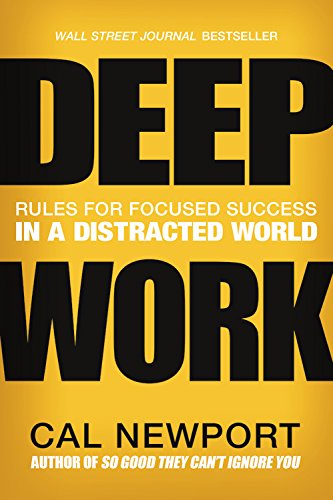
Revisiting Deep Work by Cal Newport & Why I'm Such a Devotee

August 11, 2017 Roni Loren

This week I've been nerding out with all my non-fiction book recommendations about focus and distraction, writing, and curbing the smartphone habit. Today, I've got one last pick for you. 

I blogged about Deep Work last year (almost a year ago to the day) when I read it for the first time, and I really credit it with being the book that got me thinking more deeply (haha) about this whole topic of focus in the world of distraction we face everyday. It was my ticket into exploring this whole issue on a number of levels.

So this summer, with all my reading on what the internet, smartphones, social media, etc. are doing to our lives and brains, I decided it was time for a reread of the book that started me down this path. This time, instead of racing through it like I do when I first read a book, I reread at a leisurely pace and took handwritten notes throughout. I'm not typically a re-reader but I really felt like I got even more out of this one the second time because I've been on the journey of working on my focus for a year. So things I may have missed last time landed on this read through. I also have seen some results.

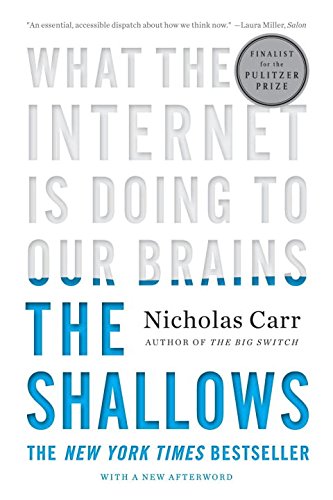
Of all the books I've recommended this week, I think this is the most "user-friendly" one because there are practical tips on what to do. Not to say the information and science of it isn't dry at times--that's the nature of this type of book and something I don't mind because I love science/research type books, but it's not a heavy or dense read like some of the others. (Like below I mention The Shallows: What the Internet is Doing to Our Brain, which was awesome but very dense with history and detailed science and not something I'd recommend to a reader who isn't used to reading that kind of thing or is looking for a general overview.)

So, if you haven't seen my previous post on Deep Work, check that out here, but today I thought I'd share some quotes and thoughts like I've been doing for the other books this week.

First, the back cover summary:

One of the most valuable skills in our economy is becoming increasingly rare. If you master this skill, you'll achieve extraordinary results.
Deep work is the ability to focus without distraction on a cognitively demanding task. It's a skill that allows you to quickly master complicated information and produce better results in less time. Deep work will make you better at what you do and provide the sense of true fulfillment that comes from craftsmanship. In short, deep work is like a super power in our increasingly competitive twenty-first century economy. And yet, most people have lost the ability to go deep-spending their days instead in a frantic blur of e-mail and social media, not even realizing there's a better way.
In DEEP WORK, author and professor Cal Newport flips the narrative on impact in a connected age. Instead of arguing distraction is bad, he instead celebrates the power of its opposite. Dividing this book into two parts, he first makes the case that in almost any profession, cultivating a deep work ethic will produce massive benefits. He then presents a rigorous training regimen, presented as a series of four "rules," for transforming your mind and habits to support this skill.
A mix of cultural criticism and actionable advice, DEEP WORK takes the reader on a journey through memorable stories-from Carl Jung building a stone tower in the woods to focus his mind, to a social media pioneer buying a round-trip business class ticket to Tokyo to write a book free from distraction in the air-and no-nonsense advice, such as the claim that most serious professionals should quit social media and that you should practice being bored. DEEP WORK is an indispensable guide to anyone seeking focused success in a distracted world.

Quotes - Thoughts - Observations


On our current state...

"There's increasing evidence that this shift toward the shallow [thinking] is not a choice that can be easily reversed. Spend enough time in a state of frenetic shallowness and you permanently reduce your capacity to perform deep work."

I can absolutely tell you that over the last year and particularly this summer when I've greatly dialed back my smartphone, social media, and internet time that I can feel the physical difference in my thinking. Last year, I was afraid that something was wrong with my memory because I couldn't hold onto so many things anymore. I was afraid that I was developing ADD (despite having no history of it). But it wasn't some illness overtaking me, it was this fast-moving world of distractibility.

I was teaching my brain to always be stimulated and jumping from task to task. But now, I can feel the quieting of my thoughts, feel the ability to focus and get into "flow" with projects coming back. I'm calmer. I'm more creative. In some ways, I feel like I've stepped out of the matrix and am seeing everything with new eyes--which sounds cheesy but is the best description of what the experience has felt like. It helps you get perspective, asking, wait, why was I doing this again? Why did I find it necessary to pick up my phone every 5 minutes or check social media every bored moment I had? Why did I feel the need to document and post so many things out to the world?  Honestly, it's jarring at first to dial it all back. And then you start reaping the benefits...

On the nervous hum...

"the lack of distraction in my life tones down that background hum of nervous mental energy that seems to increasingly pervade people's daily lives. I'm comfortable being bored, and this can be a surprisingly rewarding skill..."

Which is exactly what my experience has been. I can concentrate. I can read a book without worrying if an email has come in. I can work on writing my book and not care what's happening on twitter. I can exist in quiet with nothing to do but think and be cool with that. In fact, I've come to crave the quiet, disconnected moments like I used to when I was a daydreaming kid.

On multitasking...

"People who multitask all the time can't filter out irrelevancy. They can't manage a working memory. They're chronically distracted. They initiate much larger parts of their brain that are irrelevant to the task at hand...they're pretty much mental wrecks."

I am now a devotee to unitasking. Science tells us that we can't multitask anyway. When we think we are, we're just cycling from one task to the next at a rapid pace but still only doing one thing at a time. But if I've learned anything from all these books I've been reading, it's that unitasking with purpose is where the magic lies. It's like a superpower to be able to dedicate all of your focus to whatever it is you're working on. Like right now I am writing this post. No email or social media notifications will interrupt me (because I've turned them all off permanently both on my desktop and phone.) I will not check anything until I'm done writing this and have to go grab the links to add to this post. And I will finish this post in far less time than it used to take me to write something shorter.

On the importance of boredom...

"If every moment of potential boredom in your life--say, having to wait five minutes in line or sit alone in a restaurant until a friend arrives--is relieved with a quick glance at your smartphone, then your brain has likely been rewired to a point where...it's not ready for deep work--even if you regularly schedule time to practice this concentration."

So here's the thing. This does take some time for your brain to retrain. I can say that from my own experience and also from watching my son do the device-free summer. There's almost a detox process involved. For one, shutting down a lot of the distractions may make you feel mentally tired and even a little down. Our brains are used to the constant entertainment and stimulation. Pulling back from that and replacing it with quiet time and focused concentration is a big shift. But that state passes. For kidlet, it took about a week from what I could tell. For me, a little less, maybe because despite how distracted I was, I have been writing books for years which had trained my brain for some level of deep focus. But then that tiredness/low mood lifts and the quieter, focused pace becomes fulfilling. Creative ideas start to pop up. An internal calmness develops. Plus, you're more productive on the things that count which is reinforcing. You don't want to go back to how things were. Like kidlet has taken to saying, "I think the video games and Ipad were tricking my brain."

On social media...

Don't take the 'any benefit' approach to a social media tool. Take the craftsman approach, meaning adopt a tool only if its positive impact on your success/happiness/professional/personal life "substantially outweighs its negative impacts." 

The key there is that last portion--substantially outweighs. We can find positive aspects of any social media. But just because a positive aspect exists doesn't mean it's worth the costs of the negatives a tool may have. Most of us do social media for a combination of fun/socializing and work purposes, but as we know, social media can suck up all of our time and attention because it's meant to be addictive. Companies don't want you to leave their sites. So take a hard look at all your social media outlets and determine which ones offer you more positives than negatives and pare back or get rid of the ones that are more negatives than positives. He gives a great example in the book, using a writer as the test case, on weighing the pros and cons of Twitter. I can't post it all here but it's eye-opening. And then he gives you tools on how to tame your social media beast.

On Shallow vs. Deep Work...

And finally, how do you even know what constitutes deep work vs. shallow work? How do you know if you're spending time where you should?

Ask of a task: "How long would it take (in months) to train a smart recent college graduate with no specialized training in my field to complete this task?"

If the answer is not very long, it's shallow work. Deep work is whatever your specialized skills are. For me, deep work is writing and editing. Deep work is not crafting a clever FB contest. It doesn't mean that the shallow work is not still part of my job, but it helps determine where I should be spending most of my time and effort. I have a career because I know how to write a book. That's my specialized skill. If I spend 80% of my day doing email, Facebook, Twitter, and skimming the internet, I'm just like anyone else who knows how to use a computer. So invest the lion's share of your work time in your deep work tasks and then take breaks from focused work to do the other stuff, instead of the other way around (taking breaks from distractions to do a little deep work in between.)

There are a lot more great points in the book and I don't necessarily agree with every single tactic he suggests, but overall, it was a world-shaking book for me in a good way. It's changed how I approach things completely. I highly recommend it.

And if you want to nerd out on the topic like me, here is a further reading list:

In Book Recommendations, Books, Life, Life Lessons, Productivity, Reading, What To Read, Writing Tags deep work, cal newport, distraction, producitivity, writers and focus, focus, add, why is my memory bad, social media, the shallows, essentialsm, neuroscience, roni loren, book recommendations

Recommended Read: Still Writing by Dani Shapiro

August 9, 2017 Roni Loren

This week I've been focusing on pulling quotes from books I've read this summer about devices and the internet and all that jazz. But that's not all I've been reading this summer. So today I thought I'd take a trip down a side road and talk about a fantastic book I read about writing.

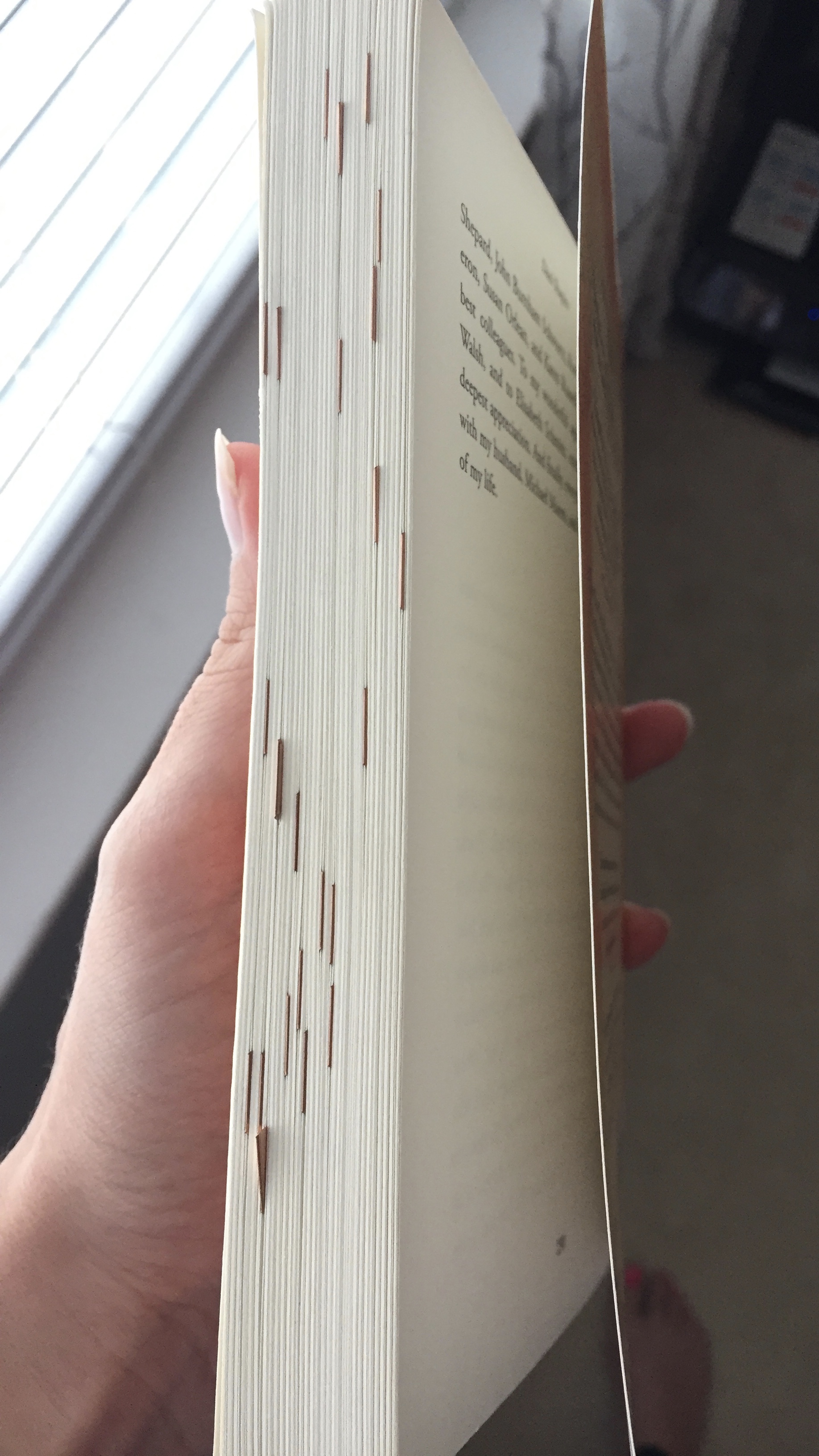
Still Writing by Dani Shapiro was so life-affirming and wonderful, not to mention beautifully written. This is the book I started my new Smartphone-Free Morning Routine with. Also, I used Book Darts to mark quotes or passages I love in my print books, and this one must weigh a pound more than when I bought it because it has so many freaking book darts lol. (see photo, all those little dark lines are the book darts.)

The book is written in essay format, so it's perfect to read a little each sitting, which is why it worked well as a morning read for me. The passages are short but filled with things to ponder, so it's one to savor rather than inhale.

I'm pulling some of my favorite quotes for y'all today to give you an idea of the style and tone, but if I quoted every passage I loved, I'd end up retyping the whole book, lol. So I'll try to choose carefully. : )

On Beginning:

"Every book, story, and essay begins with a single word. Then a sentence. Then a paragraph. These words, sentences, and paragraphs may well end up not being the actual beginning. You can't know that now. Straining to know the whole of the story before you set out is a bit like imagining great-grandchildren on a first date. But you can start with the smallest detail."

On the time between books:

(This passage resonated with me so much, and right now I'm between books, so I completely relate to this phase.)

"When I'm between books, I feel as if I will never have another story to tell. the last book has wiped me out, has taken everything from me, everything I understand and feel and know and remember, and...that's it. There's nothing left. A low-level depression sets in. The world hides its gifts from me. It has taken me years to realize that this feeling, the one of the well being empty, is as it should be. It means I've spent everything. And so I must begin again."

On why we write:

"The loneliest day in the life of a published writer may be publication day. Nothing happens. Perhaps your editor sends flowers. Maybe not. Maybe your family takes you out for dinner. But the world won’t stop to take notice. The universe is indifferent. You have put the shape of your soul between the covers of a book and no one declares it a national holiday. Someone named Booklover gives you a one-star review on Amazon.
So what is it about writing that makes it—for some of us—as necessary as breathing? It is in the thousands of days of trying, failing, sitting, thinking, resisting, dreaming, raveling, unraveling that we are at our most engaged, alert, and alive.”

On the jumping to the internet when we get stuck in our writing:

"This may be the most important piece of advice I can give you: The Internet is nothing like a cigarette break. If anything, it's the opposite. ...By the time we return to our work--if, indeed, we return to our work at all--we will be further away from our deepest impulses rather than closer to them."

On the writing life:

"when writers who are just starting out ask me when it gets easier, my answer is never. It never gets easier. I don't want to scare them, so I rarely say more than that, but the truth is that, if anything, it gets harder. The writing life isn't just filled with predictable uncertainties but with the awareness that we are always starting over again."

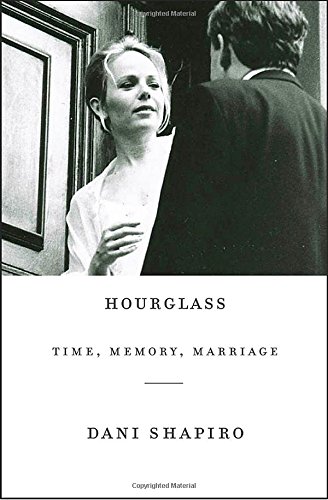
I could include so many more, but I hope that gives you an idea of how amazing this little book is. So if you're a writer, do yourself a favor and get yourself a copy. And if you're not a writer, I also highly recommend her marriage memoir Hourglass: Time, Memory, Marriage which was written in a similar style and was equally as lovely and thought-provoking. 

In Book Recommendations, Books, Writing Tags still writing, dani shapiro, hourglass, book recommendations, memoir, books on writing, writers, writer, creative life, roni loren, book darts

Research Reads from a Device-Free Summer: The End of Absence

August 7, 2017 Roni Loren

If you've been following me this summer, you know that we embarked on a device-free or screen-free summer for kidlet. (Device-free is more accurate because we allowed watching TV and movies as a family but screen-free summer had alliteration, lol.) Here are the previous posts:

  • A Screen-Free Summer for Kidlet: How, Why, & If I'll Lose my Mind
  • The 10-Day Update
  • The 5-Week Update

The experiment has gone so much better than I expected. I anticipated much more push back and problems. I expected it to be HARD. In truth, week one was hard. The rest has been...surprisingly easy. We've developed new routines and habits. Kidlet knows he's going to get his devices back in very limited quantities (20 min max a day) once summer is over, but he hasn't complained or asked for devices. The pull they had on him before (what inspired this screen-free summer idea in the first place) has disappeared. So I'm thrilled that we decided to take the leap and go cold turkey all summer (as scary as it seemed at the time.)

In addition to helping him, this whole experiment has opened my eyes a lot and helped me as well. I've wrangled a lot of my device time and social media time and have developed an aversion to things that are stealing my focus. Part of that is because I'm the type of person who wants to know ALL the things about a topic when I'm interested in it, so I have read A LOT of books about smartphones, social media, internet addiction, the changes technology has caused in how we interact, how our brains function, and how we live our lives.

I'm not sure I'm capable of summarizing the wealth of information I've read this summer, but I thought, for those interested, I could post the books I've read and share some of the quotes I highlighted while reading. So, that's what I plan to do this week. Each day, I'll post one of the books I read and the quotes I found most interesting or helpful.

Now, a disclaimer, I'm posting all of this without judgment. If you're into your devices and social media and don't feel the need to disconnect sometimes or back off of it, that's totally cool. I'm sharing this because I didn't like how things were trending with my lack of focus and my free time and family time being eaten up by my phone. So if it's not interfering with you or your family, then feel free to skip these posts. But otherwise, I think there's good food for thought in these books even if you aren't looking to make changes right now.

First up is The End of Absence: Reclaiming What We've Lost in a World of Constant Connection by Michael Harris.

This one mainly focused on our ability to be in the quiet, to be bored, to be alone. I thought he had a lot of interesting and thoughtful things to say about how the internet, smartphones, and social media have changed us.

Here are the quotes that stood out to me:

"Evolution (nature) endowed us with minds capable of fast and furious transformation, minds able to adapt to strange new environments (nurture) within a single lifetime—even within a few weeks. Therefore, we’re always products of both inherited hardware and recently downloaded software... The flip side of all this, though, is that young brains, immersed in a dozen hours of screen time a day, may be more equipped to deal with digital reality than with the decidedly less flashy reality reality that makes up our dirty, sometimes boring, often quiet, material world."
"we now need to proactively engineer moments of absence for them. We cannot afford to count on accidental absence any more than we can count on accidental veggies at dinner. Without such engineered absences (a weekend without texting, a night without screens), our children suffer as surely as do kids with endless access to fast food. The result is a digital native population that’s less well rounded than we know they could be."

This is part of what spurred me to do the device-free summer. I have an amazing kiddo. I knew he was capable of more than running to his Xbox or Ipad every free moment of the day.

"It’s becoming more and more obvious. I live on the edge of a Matrix-style sleep, as do we all. On one side: a bright future where we are always connected to our friends and lovers, never without an aid for reminiscence or a reminder of our social connections. On the other side: the twilight of our pre-Internet youths. And wasn’t there something . . . ? Some quality . . . ?"

This one above really made me think because I think sometimes what we chalk up to "nostalgia" may be more than that. There was a quality to my childhood and those pre-internet years that's missing. I've learned this summer that it's not something that can't be reclaimed. Doing things like playing old school board games with kidlet or teaching him how to cook or watching him make up his own games has recaptured some of what I didn't even realize was missing.

"Children do need moments of solitude as well as moments of healthy interaction. (How else would they learn that the mind makes its own happiness?) But too often these moments of solitude are only stumbled upon by children, whereas socialization is constantly arranged."

I loved that line about how would they learn their minds make their own happiness. 

"Despite the universality of this change, which we’re all buffeted by, there is a single, seemingly small change that I’ll be most sorry about. It will sound meaningless, but: One doesn’t see teenagers staring into space anymore. Gone is the idle mind of the adolescent."

Things I'd never thought about, but so true. Everyone has their heads down looking at their phones now.

"Solitude may cause discomfort, but that discomfort is often a healthy and inspiring sort. It’s only in moments of absence that a daydreaming person...can receive truly unexpected notions."

Sound familiar, writers?

"What will become of all those surreptitious gifts when our blank spaces are filled in with duties to 'social networks' and the relentless demands of our tech addictions?"
"I fear we are the last of the daydreamers. I fear our children will lose lack, lose absence, and never comprehend its quiet, immeasurable value."

God, I hope this is not the case. As a writer who makes her living in the world of imagination and daydreaming, I hope a new crop of writers, artists, creators is behind me. 

"Every technology will alienate you from some part of your life. That is its job. Your job is to notice. First notice the difference. And then, every time, choose."

This quote will stick with me. It's going to make me stop and think--when I look at this device, social network, whatever, what am I looking away from? I'm not a Luddite who is going to totally disconnect from the online world, but I'm becoming a lot more deliberate and choosy about how and where I'm spending my time and energy.

Needless to say, I found this book an engrossing read. I have more to share from other books the rest of this week, but I think this one did an excellent job of making the case for creating time in your life and your children's lives for solitude, quiet, absence, boredom, and blank spaces for your brain to daydream in.

Dream on, y'all. ;) 

In Book Recommendations, Books, Life, Life Lessons, Parenting, Screen-Free Summer, What To Read Tags device-free, screen-free, smartphone addiction, children, kids and devices, children and smartphones, video games, social media, the end of absences, roni loren, tech addiction
← Newer Posts Older Posts →

LATEST RELEASE

The new edition is here! Find out more

Now available! Find out more!

Add to Goodreads


series starters

“Intelligent, sweet, and fun, this romance succeeds on all levels.” —Publishers Weekly STARRED review Find out more

“Intelligent, sweet, and fun, this romance succeeds on all levels.” —Publishers Weekly STARRED review Find out more

An Entertainment Weekly, Kirkus, and Amazon Best Romance of the year Find out more

An Entertainment Weekly, Kirkus, and Amazon Best Romance of the year Find out more

Winner for Best Erotic Romance of the year! Find out more about the Pleasure Principle series

Winner for Best Erotic Romance of the year! Find out more about the Pleasure Principle series

The first in the long-running Loving on the Edge erotic romance series. Find out more

The first in the long-running Loving on the Edge erotic romance series. Find out more


 Subscribe

My Happy For Now Newsletter

Find me Online


free reading  journal!

A reading journal designed for romance readers!

A reading journal designed for romance readers! Free with newsletter sign-up.


No results found
Previous Posts
  • March 2025
  • November 2024
  • June 2024
  • March 2024
  • February 2024
  • January 2024
  • December 2023
  • March 2023
  • January 2023
  • November 2022
  • October 2022
  • July 2022
  • February 2022
  • January 2022
  • December 2021
  • November 2021
  • October 2021
  • September 2021
  • August 2021
  • July 2021
  • June 2021
  • May 2021
  • March 2021
  • February 2021
  • January 2021
  • December 2020
  • October 2020
  • August 2020
  • June 2020
  • May 2020
  • April 2020
  • March 2020
  • February 2020
  • January 2020
  • December 2019
  • November 2019
  • October 2019
  • September 2019
  • August 2019
  • July 2019
  • June 2019
  • May 2019
  • April 2019
  • March 2019
  • February 2019
  • January 2019
  • December 2018
  • November 2018
  • October 2018
  • September 2018
  • August 2018
  • July 2018
  • June 2018
  • May 2018
  • April 2018
  • March 2018
  • February 2018
  • January 2018
  • December 2017
  • November 2017
  • October 2017
  • September 2017
  • August 2017
  • July 2017
  • June 2017
  • May 2017
  • April 2017
  • March 2017
  • February 2017
  • January 2017
  • December 2016
  • November 2016
  • October 2016
  • September 2016
  • August 2016
  • July 2016
  • June 2016
  • May 2016
  • April 2016
  • March 2016
  • February 2016
  • January 2016
  • December 2015
  • October 2015
  • September 2015
  • August 2015
  • July 2015
  • June 2015
  • May 2015
  • April 2015
  • March 2015
  • January 2015
  • December 2014
  • November 2014
  • September 2014
  • August 2014
  • July 2014
  • June 2014
  • May 2014
  • April 2014
  • March 2014
  • February 2014
  • January 2014
  • December 2013
  • November 2013
  • October 2013
  • September 2013
  • August 2013
  • July 2013
  • June 2013
  • May 2013
  • April 2013
  • March 2013
  • February 2013
  • January 2013
  • December 2012
  • November 2012
  • October 2012
  • September 2012
  • August 2012
  • July 2012
  • June 2012
  • May 2012
  • April 2012
  • March 2012
  • February 2012
  • January 2012
  • December 2011
  • November 2011
  • October 2011
  • September 2011
  • August 2011
  • July 2011
  • June 2011
  • May 2011
  • April 2011
Summary Block
This block is invalid. Please check the block settings and try again.
Featured
Aenean eu leo Quam
Aenean eu leo Quam

Quisque iaculis facilisis lacinia. Mauris euismod pellentesque tellus sit amet mollis.

Read more →
Return Home
No results found

Powered by Squarespace

Site and text © 2008-2026 Roni Loren - Photos are either by the author, purchased from stock sites, or (where attributed) Creative Commons. Linkbacks, pins, and shares are always appreciated, but with the exception of promotional material (book covers, official author photo, book summaries), please do not repost material in full without permission.  And though I do not accept sponsored content for this site (all my recommendations are personal recommendations), there are some affiliate links. All Amazon and iBooks links are affiliate links.